
Practice 100 Electricity and Magnetism MCQs with answers covering electric current, resistance, Ohm’s law, magnetic fields, electromagnets, and electromagnetic induction. Perfect for exams and quick revision.
Electricity and Magnetism are fundamental branches of physics that explain how electric charges move, how magnetic fields are produced, and how these forces power modern technology. This comprehensive set of 100 Electricity and Magnetism MCQs with answers covers essential topics such as electric current, resistance, Ohm’s law, electric power, magnetic fields, electromagnets, electric motors, and electromagnetic induction. Designed for Class 7 to Class 10 students, these multiple choice questions are ideal for exam preparation, competitive tests, and concept revision, helping learners strengthen their understanding through clear, objective-based practice.
Below are 100 Multiple Choice Questions (MCQs) on Electricity and Magnetism, written in clear English, suitable for school exams, competitive tests, and quick revision.
Each question has four options and the correct answer is provided.
Electricity and Magnetism – 100 MCQs
Electricity (1–60)
-
Electric current is the flow of:
A) Neutrons
B) Protons
C) Electrons
D) Atoms
Answer: C -
SI unit of electric current is:
A) Volt
B) Ampere
C) Ohm
D) Watt
Answer: B -
The device used to measure electric current is:
A) Voltmeter
B) Ammeter
C) Galvanometer
D) Ohmmeter
Answer: B -
SI unit of electric charge is:
A) Ampere
B) Coulomb
C) Volt
D) Ohm
Answer: B -
One coulomb is equal to:
A) Charge on one electron
B) Charge on 10⁶ electrons
C) Charge flowing in 1 second at 1 ampere
D) Energy per second
Answer: C -
The SI unit of electric potential difference is:
A) Ohm
B) Watt
C) Volt
D) Ampere
Answer: C -
The instrument used to measure voltage is:
A) Ammeter
B) Voltmeter
C) Galvanometer
D) Rheostat
Answer: B -
Electric resistance depends on:
A) Length
B) Area
C) Material
D) All of these
Answer: D -
SI unit of resistance is:
A) Volt
B) Ampere
C) Ohm
D) Watt
Answer: C -
Ohm’s law relates:
A) Power and time
B) Voltage, current, resistance
C) Energy and power
D) Charge and mass
Answer: B -
Ohm’s law formula is:
A) V = IR
B) P = VI
C) E = mc²
D) Q = It
Answer: A -
Resistance increases if the length of a wire:
A) Decreases
B) Remains same
C) Increases
D) Becomes zero
Answer: C -
A good conductor of electricity is:
A) Rubber
B) Plastic
C) Copper
D) Glass
Answer: C -
An insulator is:
A) Copper
B) Aluminum
C) Rubber
D) Iron
Answer: C -
The flow of charges in a closed circuit is called:
A) Voltage
B) Resistance
C) Current
D) Power
Answer: C -
Electric power is measured in:
A) Joule
B) Watt
C) Volt
D) Ohm
Answer: B -
Formula for electric power is:
A) P = VI
B) P = IR
C) P = V/R
D) P = I/R
Answer: A -
Electric energy is measured in:
A) Watt
B) Joule
C) Ampere
D) Volt
Answer: B -
Commercial unit of electrical energy is:
A) Joule
B) Watt
C) kWh
D) Volt
Answer: C -
One kilowatt-hour equals:
A) 100 J
B) 1000 J
C) 3.6 × 10⁶ J
D) 360 J
Answer: C -
Heating effect of electric current was studied by:
A) Ohm
B) Joule
C) Faraday
D) Maxwell
Answer: B -
Joule’s law of heating is:
A) H ∝ I²Rt
B) H ∝ VIt
C) H ∝ IR
D) H ∝ V²R
Answer: A -
Fuse wire is made of:
A) Copper
B) Aluminum
C) Tin-lead alloy
D) Iron
Answer: C -
A fuse is connected in:
A) Parallel
B) Series
C) Mixed
D) Earth wire
Answer: B -
Electric bulbs use:
A) Copper filament
B) Iron filament
C) Tungsten filament
D) Aluminum filament
Answer: C -
A short circuit occurs when:
A) Resistance increases
B) Current decreases
C) Live and neutral wires touch
D) Voltage becomes zero
Answer: C -
Overloading causes:
A) Decrease in current
B) Heating of wires
C) Less resistance
D) No effect
Answer: B -
Conventional current flows from:
A) Negative to positive
B) Positive to negative
C) Randomly
D) Earth to wire
Answer: B -
A battery converts:
A) Mechanical to electrical energy
B) Chemical to electrical energy
C) Electrical to mechanical energy
D) Heat to electrical energy
Answer: B -
Resistance of an ideal conductor is:
A) High
B) Low
C) Zero
D) Infinite
Answer: C -
Resistance decreases when temperature of a metal:
A) Increases
B) Decreases
C) Remains same
D) Becomes zero
Answer: B -
A resistor connected in series:
A) Increases current
B) Decreases resistance
C) Increases total resistance
D) Has same voltage
Answer: C -
In a parallel circuit, voltage across each component is:
A) Different
B) Zero
C) Same
D) Infinite
Answer: C -
The path of electric current must be:
A) Open
B) Closed
C) Broken
D) Insulated
Answer: B -
The device used to control current is:
A) Voltmeter
B) Rheostat
C) Fuse
D) Battery
Answer: B -
Electric current produces:
A) Heat only
B) Magnetic effect
C) Chemical effect
D) All of these
Answer: D -
Lightning is a form of:
A) Magnetic discharge
B) Electric discharge
C) Heat radiation
D) Sound wave
Answer: B -
Static electricity is produced by:
A) Heating
B) Rubbing
C) Cooling
D) Melting
Answer: B -
The earth wire is used for:
A) Lighting
B) Safety
C) Heating
D) Decoration
Answer: B -
Higher resistance causes current to:
A) Increase
B) Decrease
C) Remain same
D) Become zero
Answer: B

Magnetism (61–100)
-
A magnet has:
A) One pole
B) Two poles
C) Three poles
D) No poles
Answer: B -
Like magnetic poles:
A) Attract
B) Repel
C) Neutralize
D) Destroy
Answer: B -
Unlike magnetic poles:
A) Repel
B) Ignore
C) Attract
D) Disappear
Answer: C -
The ends of a magnet are called:
A) Charges
B) Edges
C) Poles
D) Centers
Answer: C -
SI unit of magnetic field is:
A) Tesla
B) Weber
C) Ampere
D) Gauss
Answer: A -
The device used to detect magnetic field is:
A) Ammeter
B) Compass
C) Voltmeter
D) Barometer
Answer: B -
Magnetic field lines:
A) Cross each other
B) Are straight
C) Never intersect
D) End at poles
Answer: C -
Magnetic field is strongest at:
A) Center
B) Middle
C) Poles
D) Edges
Answer: C -
The region around a magnet where force is felt is called:
A) Magnetic area
B) Magnetic field
C) Magnetic zone
D) Magnetic energy
Answer: B -
Earth behaves like a:
A) Electric dipole
B) Bar magnet
C) Iron rod
D) Battery
Answer: B -
A compass needle is a:
A) Iron piece
B) Magnetic needle
C) Steel wire
D) Copper strip
Answer: B -
Magnetic materials include:
A) Copper
B) Plastic
C) Iron
D) Wood
Answer: C -
Non-magnetic material is:
A) Iron
B) Nickel
C) Steel
D) Plastic
Answer: D -
The process of making a magnet is called:
A) Insulation
B) Magnetization
C) Electrification
D) Polarization
Answer: B -
Cutting a magnet into two pieces results in:
A) One magnet
B) Two magnets
C) Loss of magnetism
D) One pole
Answer: B -
Magnetic field around a current-carrying conductor was discovered by:
A) Faraday
B) Maxwell
C) Oersted
D) Newton
Answer: C -
An electromagnet is formed by:
A) Permanent magnet
B) Current-carrying coil
C) Steel rod
D) Plastic wire
Answer: B -
Strength of an electromagnet can be increased by:
A) Reducing current
B) Using air core
C) Increasing current
D) Cutting wire
Answer: C -
Electromagnets are used in:
A) Cranes
B) Fans
C) Bulbs
D) Switches
Answer: A -
Permanent magnets are usually made of:
A) Soft iron
B) Steel
C) Copper
D) Aluminum
Answer: B -
Soft iron is used in electromagnets because:
A) It is expensive
B) It magnetizes easily
C) It is light
D) It is colorful
Answer: B -
Magnetic field lines emerge from:
A) South pole
B) North pole
C) Both poles
D) Center
Answer: B -
Magnetic field lines enter:
A) North pole
B) South pole
C) Center
D) Air
Answer: B -
The SI unit of magnetic flux is:
A) Tesla
B) Weber
C) Ampere
D) Henry
Answer: B -
A current-carrying wire behaves like:
A) Resistor
B) Magnet
C) Battery
D) Fuse
Answer: B -
Fleming’s right-hand rule is used for:
A) Heating effect
B) Direction of force
C) Direction of current induced
D) Electric power
Answer: C -
Fleming’s left-hand rule is used for:
A) Electric current
B) Magnetic field
C) Direction of force on conductor
D) Resistance
Answer: C -
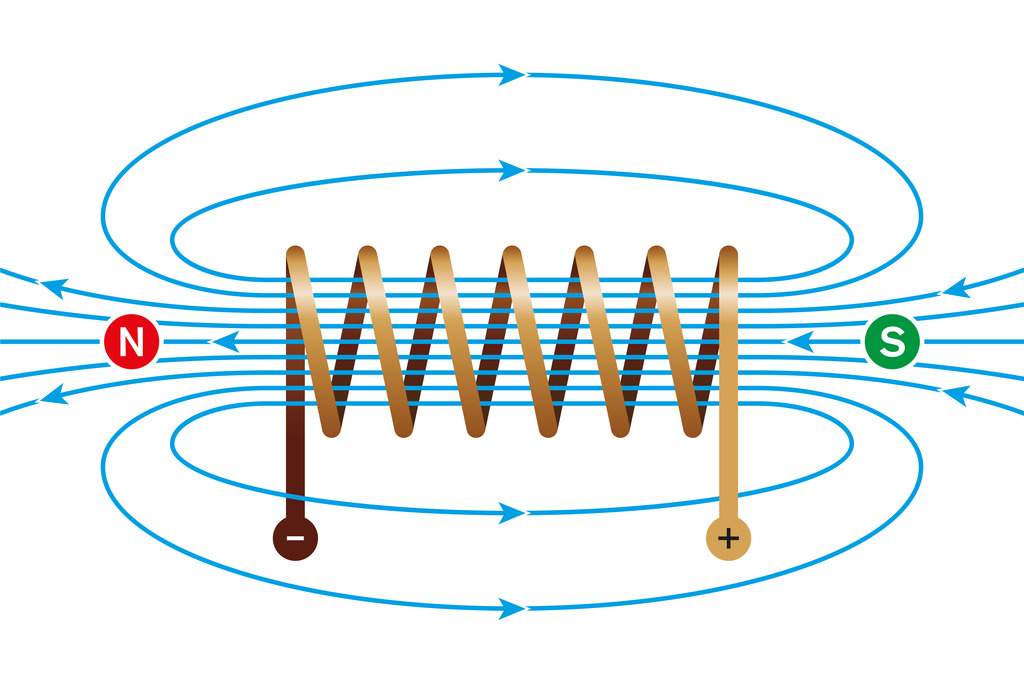
Magnetic field inside a solenoid is:
A) Zero
B) Weak
C) Uniform
D) Random
Answer: C -
A solenoid acts like:
A) Battery
B) Resistor
C) Bar magnet
D) Capacitor
Answer: C -
Increasing number of turns in a coil:
A) Decreases magnetism
B) No effect
C) Increases magnetism
D) Removes field
Answer: C -
The force on a moving charge in magnetic field is:
A) Electric force
B) Gravitational force
C) Magnetic force
D) Nuclear force
Answer: C -
Magnetic effect of current is used in:
A) Heater
B) Electric motor
C) Electric iron
D) Fuse
Answer: B -
Electric motor converts:
A) Electrical to mechanical energy
B) Mechanical to electrical energy
C) Heat to electrical energy
D) Chemical to heat energy
Answer: A -
Generator works on the principle of:
A) Heating effect
B) Chemical effect
C) Electromagnetic induction
D) Static electricity
Answer: C -
Magnetic levitation uses:
A) Gravity
B) Friction
C) Magnetic force
D) Heat
Answer: C -
The strength of magnetic field depends on:
A) Current
B) Distance
C) Medium
D) All of these
Answer: D -
A magnet attracts:
A) All metals
B) Only iron
C) Magnetic materials
D) All objects
Answer: C -
Magnetic poles always exist in:
A) Pairs
B) Singles
C) Triples
D) Groups
Answer: A -
Demagnetization can be done by:
A) Heating
B) Hammering
C) Passing AC
D) All of these
Answer: D -
The phenomenon of producing current by changing magnetic field is called:
A) Magnetization
B) Electromagnetic induction
C) Electric conduction
D) Polarization
Answer: B
