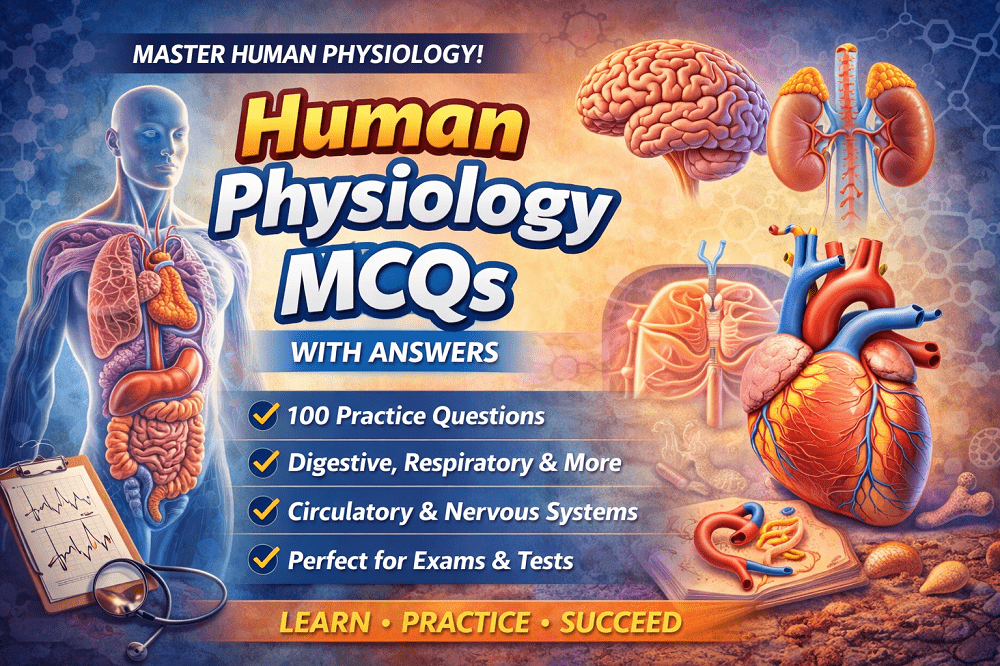
Practice 100 Human Physiology MCQs with answers covering digestive, respiratory, circulatory, nervous, endocrine, and excretory systems. Ideal for students and competitive exams.
Human Physiology focuses on understanding how different organs and systems of the human body function together to maintain life. A strong grasp of physiological concepts such as digestion, respiration, circulation, excretion, nervous coordination, and hormonal regulation is essential for biology students and competitive exam aspirants. This article presents 100 well-structured Human Physiology MCQs with answers, designed to improve conceptual clarity, support quick revision, and enhance exam readiness. These human physiology multiple choice questions are ideal for students preparing for school exams, entrance tests, and general science assessments.
1. Human physiology is the study of:
A. Cells and tissues
B. Functions of the human body
C. Diseases
D. Plant organs
Answer: B
2. The functional unit of the kidney is:
A. Neuron
B. Nephron
C. Alveolus
D. Glomerulus
Answer: B
3. Which blood cells help in clotting?
A. RBC
B. WBC
C. Platelets
D. Plasma
Answer: C
4. Which component of blood transports oxygen?
A. Plasma
B. WBC
C. RBC
D. Platelets
Answer: C
5. The normal human body temperature is:
A. 36–37°C
B. 35–36°C
C. 37–38°C
D. 38–39°C
Answer: A
6. Which organ produces insulin?
A. Liver
B. Pancreas
C. Stomach
D. Kidney
Answer: B
7. Which organ produces bile?
A. Gallbladder
B. Liver
C. Pancreas
D. Small intestine
Answer: B
8. The largest organ in the human body is:
A. Brain
B. Liver
C. Skin
D. Heart
Answer: C
9. Which muscle is voluntary?
A. Heart
B. Skeletal
C. Smooth
D. Diaphragm
Answer: B
10. Which system controls body functions by hormones?
A. Nervous
B. Circulatory
C. Endocrine
D. Respiratory
Answer: C
11. Which system controls rapid body responses?
A. Endocrine
B. Nervous
C. Digestive
D. Respiratory
Answer: B
12. The functional unit of the lung is:
A. Nephron
B. Alveolus
C. Bronchiole
D. Capillary
Answer: B
13. Gas exchange occurs in:
A. Bronchi
B. Trachea
C. Alveoli
D. Diaphragm
Answer: C
14. Which component of blood is liquid?
A. Plasma
B. RBC
C. WBC
D. Platelets
Answer: A
15. Hemoglobin is present in:
A. Plasma
B. RBC
C. WBC
D. Platelets
Answer: B
16. Heart rate is measured in:
A. bpm
B. ml
C. mg
D. mmHg
Answer: A
17. Systolic pressure is measured during:
A. Heart relaxation
B. Heart contraction
C. Breathing
D. Blood clotting
Answer: B
18. Diastolic pressure is measured during:
A. Heart contraction
B. Heart relaxation
C. Breathing
D. Digestion
Answer: B
19. The pacemaker of the heart is:
A. AV node
B. SA node
C. Purkinje fibers
D. Bundle of His
Answer: B
20. The largest vein in the body is:
A. Jugular vein
B. Pulmonary vein
C. Vena cava
D. Femoral vein
Answer: C
21. The largest artery in the body is:
A. Pulmonary artery
B. Carotid artery
C. Aorta
D. Coronary artery
Answer: C
22. Which WBC fights bacterial infections?
A. Neutrophils
B. Eosinophils
C. Basophils
D. Lymphocytes
Answer: A
23. Which WBC produces antibodies?
A. Neutrophils
B. Lymphocytes
C. Monocytes
D. Basophils
Answer: B
24. Which enzyme digests starch?
A. Lipase
B. Amylase
C. Protease
D. Pepsin
Answer: B
25. Which enzyme digests proteins in the stomach?
A. Lipase
B. Amylase
C. Pepsin
D. Trypsin
Answer: C
26. Lipase digests:
A. Carbohydrates
B. Proteins
C. Fats
D. Nucleic acids
Answer: C
27. Bile helps in the digestion of:
A. Proteins
B. Fats
C. Carbohydrates
D. Vitamins
Answer: B
28. Vitamin D is synthesized in the:
A. Liver
B. Kidney
C. Skin
D. Pancreas
Answer: C
29. The functional unit of the liver is:
A. Hepatocyte
B. Lobule
C. Nephron
D. Alveolus
Answer: B
30. The hormone regulating blood sugar is:
A. Adrenaline
B. Glucagon
C. Insulin
D. Cortisol
Answer: C
31. Glucagon increases blood glucose by:
A. Glycolysis
B. Glycogenolysis
C. Protein synthesis
D. Fat storage
Answer: B
32. The hormone adrenaline is secreted by:
A. Thyroid
B. Pituitary
C. Adrenal gland
D. Pancreas
Answer: C
33. Which hormone regulates calcium levels?
A. Calcitonin
B. Insulin
C. Glucagon
D. Cortisol
Answer: A
34. Thyroid gland secretes:
A. Thyroxine
B. Insulin
C. Adrenaline
D. Cortisol
Answer: A
35. Parathyroid glands regulate:
A. Blood sugar
B. Calcium and phosphorus
C. Blood pressure
D. Heart rate
Answer: B
36. Which part of the brain controls voluntary movements?
A. Cerebellum
B. Cerebrum
C. Medulla oblongata
D. Hypothalamus
Answer: B
37. Which part of the brain controls balance?
A. Cerebellum
B. Cerebrum
C. Medulla
D. Hypothalamus
Answer: A
38. Medulla oblongata regulates:
A. Voluntary movements
B. Heart rate and respiration
C. Memory
D. Vision
Answer: B
39. Hypothalamus regulates:
A. Endocrine system and temperature
B. Vision
C. Hearing
D. Smell
Answer: A
40. Reflex action is controlled by:
A. Brain
B. Spinal cord
C. Cerebellum
D. Medulla
Answer: B
41. The speed of nerve impulse is:
A. 1 m/s
B. 10 m/s
C. 100–120 m/s
D. 0.1 m/s
Answer: C
42. Which neurotransmitter is excitatory?
A. GABA
B. Acetylcholine
C. Glycine
D. Serotonin
Answer: B
43. Which neurotransmitter is inhibitory?
A. Acetylcholine
B. GABA
C. Dopamine
D. Epinephrine
Answer: B
44. Synapse is:
A. Junction between muscle and bone
B. Junction between two neurons
C. Gap in muscles
D. Blood vessel junction
Answer: B
45. Which organ stores bile?
A. Liver
B. Gallbladder
C. Pancreas
D. Stomach
Answer: B
46. The small intestine secretes:
A. Pepsin
B. Trypsin
C. Maltase and lactase
D. Lipase only
Answer: C
47. Absorption of nutrients mainly occurs in:
A. Stomach
B. Large intestine
C. Small intestine
D. Esophagus
Answer: C
48. Which part of the nephron filters blood?
A. Loop of Henle
B. Bowman’s capsule
C. Collecting duct
D. Renal pelvis
Answer: B
49. Reabsorption of water occurs in:
A. Bowman’s capsule
B. Loop of Henle
C. Collecting duct
D. Both B and C
Answer: D
50. Urine is stored in:
A. Kidney
B. Ureter
C. Bladder
D. Urethra
Answer: C
51. The male hormone testosterone is secreted by:
A. Pituitary
B. Testes
C. Adrenal gland
D. Thyroid
Answer: B
52. Female hormone estrogen is secreted by:
A. Ovary
B. Pituitary
C. Adrenal gland
D. Thyroid
Answer: A
53. Progesterone is secreted by:
A. Testes
B. Ovary
C. Adrenal gland
D. Thyroid
Answer: B
54. Sperms are produced in:
A. Ovary
B. Testes
C. Seminal vesicle
D. Prostate
Answer: B
55. Ovum is produced in:
A. Ovary
B. Uterus
C. Fallopian tube
D. Cervix
Answer: A
56. Fertilization occurs in:
A. Ovary
B. Fallopian tube
C. Uterus
D. Vagina
Answer: B
57. Gestation period in humans is:
A. 6 months
B. 7 months
C. 9 months
D. 12 months
Answer: C
58. The largest gland in the human body is:
A. Pancreas
B. Liver
C. Thyroid
D. Pituitary
Answer: B
59. Bile is stored in:
A. Liver
B. Gallbladder
C. Pancreas
D. Small intestine
Answer: B
60. Peristalsis occurs in:
A. Stomach
B. Esophagus
C. Small intestine
D. All of these
Answer: D
61. Heartbeat is regulated by:
A. SA node
B. AV node
C. Purkinje fibers
D. All of these
Answer: D
62. Which vitamin is essential for blood clotting?
A. Vitamin A
B. Vitamin K
C. Vitamin C
D. Vitamin D
Answer: B
63. Which vitamin prevents scurvy?
A. Vitamin A
B. Vitamin C
C. Vitamin D
D. Vitamin K
Answer: B
64. Which vitamin is fat-soluble?
A. Vitamin C
B. Vitamin B
C. Vitamin D
D. Vitamin B12
Answer: C
65. The process of RBC formation is called:
A. Leukopoiesis
B. Thrombopoiesis
C. Hemopoiesis
D. Erythropoiesis
Answer: D
66. White blood cells are produced in:
A. Liver
B. Bone marrow
C. Kidney
D. Lymph nodes
Answer: B
67. Platelets are fragments of:
A. RBC
B. Megakaryocytes
C. WBC
D. Plasma
Answer: B
68. Blood plasma contains:
A. Proteins, water, and salts
B. RBC
C. WBC
D. Platelets
Answer: A
69. Normal blood pressure is:
A. 120/80 mmHg
B. 100/70 mmHg
C. 110/90 mmHg
D. 140/90 mmHg
Answer: A
70. The process of excretion removes:
A. CO₂ and nitrogenous wastes
B. Oxygen
C. Nutrients
D. Water only
Answer: A
71. Excretion is performed mainly by:
A. Kidney
B. Liver
C. Lungs
D. Skin
Answer: A
72. Sweat is produced by:
A. Sebaceous glands
B. Salivary glands
C. Sweat glands
D. Endocrine glands
Answer: C
73. Sebaceous glands secrete:
A. Sweat
B. Oil
C. Mucus
D. Hormones
Answer: B
74. Lymph is:
A. Blood plasma
B. White blood cells
C. Interstitial fluid
D. Platelets
Answer: C
75. Lymph is drained into:
A. Heart
B. Veins
C. Arteries
D. Kidneys
Answer: B
76. The outer layer of skin is:
A. Dermis
B. Epidermis
C. Hypodermis
D. Subcutaneous
Answer: B
77. The inner layer of skin is:
A. Epidermis
B. Dermis
C. Hypodermis
D. Sebaceous
Answer: B
78. Which hormone controls water balance?
A. ADH
B. Insulin
C. Thyroxine
D. Glucagon
Answer: A
79. ADH is secreted by:
A. Pituitary gland
B. Thyroid
C. Pancreas
D. Adrenal
Answer: A
80. Which organ secretes digestive enzymes into small intestine?
A. Liver
B. Pancreas
C. Gallbladder
D. Stomach
Answer: B
81. Gastric juice contains:
A. HCl, pepsin, mucus
B. Bile
C. Pancreatic juice
D. Saliva
Answer: A
82. Saliva contains which enzyme?
A. Amylase
B. Lipase
C. Pepsin
D. Trypsin
Answer: A
83. Which part of brain controls emotions?
A. Cerebrum
B. Hypothalamus
C. Cerebellum
D. Medulla
Answer: B
84. Which part of brain controls memory?
A. Cerebrum
B. Cerebellum
C. Hypothalamus
D. Medulla
Answer: A
85. Blood is pumped from heart to lungs via:
A. Aorta
B. Pulmonary artery
C. Vena cava
D. Coronary artery
Answer: B
86. Blood returns to heart from lungs via:
A. Pulmonary artery
B. Pulmonary vein
C. Aorta
D. Vena cava
Answer: B
87. Which chamber of heart receives oxygenated blood?
A. Right atrium
B. Right ventricle
C. Left atrium
D. Left ventricle
Answer: C
88. Which chamber of heart pumps oxygenated blood to body?
A. Right atrium
B. Right ventricle
C. Left atrium
D. Left ventricle
Answer: D
89. Which chamber receives deoxygenated blood?
A. Right atrium
B. Right ventricle
C. Left atrium
D. Left ventricle
Answer: A
90. Which chamber pumps blood to lungs?
A. Right atrium
B. Right ventricle
C. Left atrium
D. Left ventricle
Answer: B
91. Respiratory rate in adults at rest:
A. 8–10 per min
B. 12–20 per min
C. 20–25 per min
D. 25–30 per min
Answer: B
92. Tidal volume is:
A. Maximum air in lungs
B. Air breathed in/out at rest
C. Residual air
D. Total lung capacity
Answer: B
93. Vital capacity is:
A. Maximum air lungs can hold
B. Residual air
C. Air breathed at rest
D. Dead space
Answer: A
94. Residual volume is:
A. Air in lungs after forced expiration
B. Maximum inhalation
C. Tidal air
D. Vital capacity
Answer: A
95. Which pigment carries oxygen in RBC?
A. Myoglobin
B. Hemoglobin
C. Chlorophyll
D. Melanin
Answer: B
96. Which organ produces erythropoietin?
A. Kidney
B. Liver
C. Bone marrow
D. Heart
Answer: A
97. Which blood cells destroy pathogens?
A. RBC
B. WBC
C. Platelets
D. Plasma
Answer: B
98. Normal WBC count is:
A. 4000–11000/mm³
B. 1000–2000/mm³
C. 2000–3000/mm³
D. 12000–15000/mm³
Answer: A
99. Normal RBC count in humans is:
A. 4–6 million/mm³
B. 1–2 million/mm³
C. 2–3 million/mm³
D. 6–8 million/mm³
Answer: A
100. Which organ stores vitamins A, D, E, K?
A. Kidney
B. Liver
C. Pancreas
D. Gallbladder
Answer: B