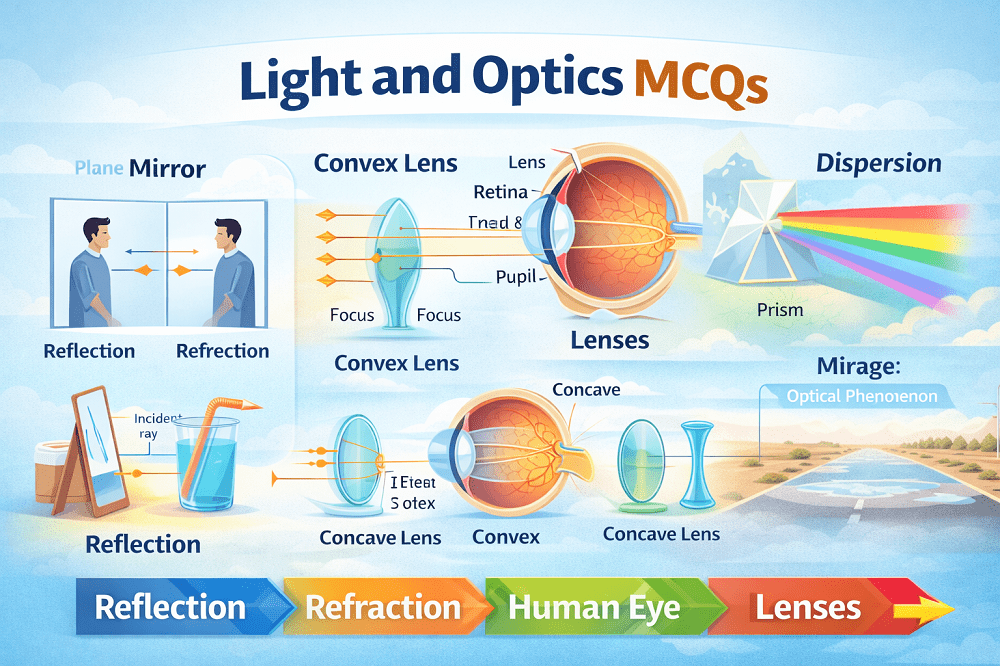
Practice 100 Light and Optics MCQs with answers covering reflection, refraction, mirrors, lenses, human eye, dispersion, and optical phenomena. Ideal for school exams, competitive tests, and quick physics revision.
Light and Optics play a vital role in helping us understand how light behaves and how images are formed through reflection and refraction. This comprehensive set of 100 Light and Optics MCQs with answers covers key physics concepts such as rectilinear propagation of light, mirrors, lenses, prisms, dispersion, the human eye, and common optical phenomena. Carefully designed for Class 7 to Class 10 students, these multiple choice questions are ideal for exam preparation, competitive tests, and quick revision, helping learners strengthen their conceptual clarity and problem-solving skills through objective-based practice.
Below are 100 Multiple Choice Questions (MCQs) on Light and Optics, written in clear English, suitable for school exams, competitive tests, and revision.
Each question has four options and the correct answer is given.
Light and Optics – 100 MCQs
Basics of Light (1–30)
-
Light is a form of:
A) Matter
B) Energy
C) Force
D) Sound
Answer: B -
The speed of light in vacuum is approximately:
A) 3 × 10⁶ m/s
B) 3 × 10⁷ m/s
C) 3 × 10⁸ m/s
D) 3 × 10⁹ m/s
Answer: C -
Light travels in:
A) Curved lines
B) Zig-zag paths
C) Straight lines
D) Circular paths
Answer: C -
The phenomenon that proves light travels in straight lines is:
A) Reflection
B) Refraction
C) Rectilinear propagation
D) Dispersion
Answer: C -
Which object emits its own light?
A) Moon
B) Mirror
C) Bulb
D) Book
Answer: C -
Which of the following is a natural source of light?
A) Torch
B) Candle
C) Sun
D) Bulb
Answer: C -
Luminous objects are those which:
A) Reflect light
B) Absorb light
C) Emit light
D) Block light
Answer: C -
Non-luminous objects:
A) Produce light
B) Reflect light
C) Emit heat
D) Have no mass
Answer: B -
The formation of shadows shows:
A) Reflection of light
B) Refraction of light
C) Straight-line travel of light
D) Scattering of light
Answer: C -
An opaque object:
A) Allows all light to pass
B) Allows partial light
C) Does not allow light to pass
D) Emits light
Answer: C -
A translucent object:
A) Allows all light
B) Allows no light
C) Allows some light
D) Reflects all light
Answer: C -
Transparent objects:
A) Block light
B) Allow light completely
C) Scatter light
D) Absorb light
Answer: B -
The image formed by a pinhole camera is:
A) Erect and real
B) Virtual and inverted
C) Real and inverted
D) Virtual and erect
Answer: C -
The size of the image in a pinhole camera depends on:
A) Size of pinhole
B) Distance of screen
C) Distance of object
D) All of these
Answer: D -
Light travels fastest in:
A) Water
B) Glass
C) Air
D) Vacuum
Answer: D -
The unit of wavelength is:
A) Meter
B) Hertz
C) Joule
D) Candela
Answer: A -
The color of light depends on:
A) Speed
B) Frequency
C) Intensity
D) Amplitude
Answer: B -
White light is a mixture of:
A) Three colors
B) Five colors
C) Seven colors
D) Ten colors
Answer: C -
The splitting of white light into its colors is called:
A) Reflection
B) Refraction
C) Dispersion
D) Diffraction
Answer: C -
Which device is used to split white light?
A) Lens
B) Prism
C) Mirror
D) Microscope
Answer: B -
The sequence of colors in a spectrum is:
A) VIBGYOR
B) RGB
C) CMYK
D) ROYGBIV
Answer: A -
The color with maximum wavelength is:
A) Violet
B) Green
C) Blue
D) Red
Answer: D -
The color with minimum wavelength is:
A) Red
B) Yellow
C) Blue
D) Violet
Answer: D -
Rainbow is formed due to:
A) Reflection only
B) Refraction only
C) Dispersion only
D) Dispersion, refraction, and reflection
Answer: D -
Scattering of light causes:
A) Blue color of sky
B) Red color of sun at noon
C) Black color of night
D) White clouds
Answer: A -
The color of sky appears blue because:
A) Longer wavelengths scatter more
B) Shorter wavelengths scatter more
C) All colors scatter equally
D) No scattering
Answer: B -
Sun appears red at sunrise and sunset due to:
A) Dispersion
B) Reflection
C) Scattering
D) Refraction
Answer: C -
The phenomenon of bending of light at boundary is:
A) Reflection
B) Refraction
C) Dispersion
D) Diffraction
Answer: B -
Refraction occurs because:
A) Light changes speed
B) Light reflects
C) Light scatters
D) Light absorbs energy
Answer: A -
The ratio of speed of light in vacuum to speed in a medium is called:
A) Density
B) Refractive index
C) Reflection coefficient
D) Optical power
Answer: B
Reflection and Mirrors (31–60)
-
Reflection of light follows:
A) One law
B) Two laws
C) Three laws
D) Four laws
Answer: B -
Angle of incidence is equal to:
A) Angle of refraction
B) Angle of deviation
C) Angle of reflection
D) Angle of prism
Answer: C -
The mirror that always forms a virtual and erect image is:
A) Concave
B) Convex
C) Plane
D) Both B and C
Answer: D -
Image formed by a plane mirror is:
A) Real
B) Virtual
C) Inverted
D) Enlarged
Answer: B -
Magnification of a plane mirror is:
A) Less than 1
B) Greater than 1
C) Equal to 1
D) Zero
Answer: C -
Concave mirror is also called:
A) Diverging mirror
B) Converging mirror
C) Plane mirror
D) Cylindrical mirror
Answer: B -
Convex mirror is also called:
A) Converging mirror
B) Diverging mirror
C) Plane mirror
D) Spherical lens
Answer: B -
The image formed by a convex mirror is:
A) Real and inverted
B) Virtual and erect
C) Real and erect
D) Virtual and inverted
Answer: B -
Rear-view mirrors in vehicles are:
A) Plane mirrors
B) Concave mirrors
C) Convex mirrors
D) Parabolic mirrors
Answer: C -
The focus of a concave mirror is:
A) Real
B) Virtual
C) At infinity
D) At pole
Answer: A -
The focal length of a convex mirror is:
A) Positive
B) Negative
C) Zero
D) Infinite
Answer: A -
The center of curvature of a mirror is:
A) On the surface
B) At focus
C) At midpoint of radius
D) On principal axis
Answer: D -
Radius of curvature is:
A) Twice focal length
B) Half focal length
C) Equal to focal length
D) Zero
Answer: A -
The point where principal axis meets mirror is:
A) Focus
B) Pole
C) Center
D) Vertex
Answer: B -
Image formed by concave mirror for object beyond C is:
A) Virtual and erect
B) Real and inverted
C) Virtual and inverted
D) Real and erect
Answer: B -
For shaving mirror, we use:
A) Plane mirror
B) Convex mirror
C) Concave mirror
D) Cylindrical mirror
Answer: C -
A convex mirror gives:
A) Narrow field of view
B) Wide field of view
C) No field of view
D) Blurred image
Answer: B -
Mirror formula is:
A) 1/f = 1/v + 1/u
B) f = u + v
C) f = uv
D) v = u
Answer: A -
Magnification for mirrors is:
A) m = u/v
B) m = v/u
C) m = f/u
D) m = f/v
Answer: B -
Image distance is measured from:
A) Focus
B) Center
C) Pole
D) Object
Answer: C
Refraction, Lenses & Optical Phenomena (51–100)
-
A lens that converges light rays is:
A) Concave
B) Convex
C) Cylindrical
D) Plane
Answer: B -
A concave lens always forms image which is:
A) Real and inverted
B) Virtual and erect
C) Real and erect
D) Virtual and inverted
Answer: B -
Power of lens is measured in:
A) Watt
B) Meter
C) Dioptre
D) Joule
Answer: C -
Formula for power of lens is:
A) P = f
B) P = 1/f
C) P = f²
D) P = u/v
Answer: B -
The SI unit of focal length is:
A) Meter
B) Centimeter
C) Dioptre
D) Second
Answer: A -
Convex lens has:
A) Negative power
B) Positive power
C) Zero power
D) Infinite power
Answer: B -
Concave lens has:
A) Positive power
B) Zero power
C) Negative power
D) Infinite power
Answer: C -
Lens formula is:
A) 1/f = 1/v + 1/u
B) f = u + v
C) f = uv
D) v = u
Answer: A -
Human eye lens is:
A) Concave
B) Convex
C) Plane
D) Cylindrical
Answer: B -
Defect of vision where distant objects appear blurred is:
A) Hypermetropia
B) Myopia
C) Presbyopia
D) Astigmatism
Answer: B -
Myopia is corrected using:
A) Convex lens
B) Concave lens
C) Plane mirror
D) Prism
Answer: B -
Hypermetropia is corrected using:
A) Concave lens
B) Convex lens
C) Cylindrical lens
D) Mirror
Answer: B -
The least distance of distinct vision is:
A) 15 cm
B) 20 cm
C) 25 cm
D) 30 cm
Answer: C -
Defect of vision in old age is:
A) Myopia
B) Hypermetropia
C) Presbyopia
D) Color blindness
Answer: C -
A prism bends light due to:
A) Reflection
B) Scattering
C) Refraction
D) Diffraction
Answer: C -
Twinkling of stars is due to:
A) Reflection
B) Dispersion
C) Atmospheric refraction
D) Scattering
Answer: C -
Apparent shift of sun position is due to:
A) Dispersion
B) Reflection
C) Refraction
D) Absorption
Answer: C -
Total internal reflection occurs when:
A) Light goes from rarer to denser
B) Angle of incidence < critical angle
C) Light goes from denser to rarer medium
D) Light is scattered
Answer: C -
Optical fibers work on:
A) Refraction
B) Reflection
C) Dispersion
D) Total internal reflection
Answer: D -
Mirage is formed due to:
A) Dispersion
B) Reflection
C) Refraction
D) Total internal reflection
Answer: D -
Telescope is used to see:
A) Nearby objects
B) Distant objects
C) Microscopic objects
D) Internal organs
Answer: B -
Microscope is used to see:
A) Stars
B) Distant planets
C) Very small objects
D) Sun
Answer: C -
Camera uses:
A) Concave lens
B) Convex lens
C) Plane mirror
D) Prism
Answer: B -
Image formed on retina is:
A) Virtual and erect
B) Real and inverted
C) Virtual and inverted
D) Real and erect
Answer: B -
Color blindness is caused due to defect in:
A) Cornea
B) Retina
C) Iris
D) Lens
Answer: B -
Near point of a normal eye is:
A) 10 cm
B) 15 cm
C) 20 cm
D) 25 cm
Answer: D -
Far point of normal eye is:
A) 25 cm
B) 50 cm
C) Infinity
D) 1 m
Answer: C -
The phenomenon used in periscope is:
A) Refraction
B) Dispersion
C) Reflection
D) Scattering
Answer: C -
White light splits into colors due to:
A) Reflection
B) Refraction
C) Dispersion
D) Diffraction
Answer: C -
The angle between incident ray and normal is called:
A) Angle of reflection
B) Angle of refraction
C) Angle of incidence
D) Angle of deviation
Answer: C -
The angle between reflected ray and normal is:
A) Angle of incidence
B) Angle of reflection
C) Angle of refraction
D) Angle of deviation
Answer: B -
Speed of light is maximum in:
A) Water
B) Glass
C) Air
D) Vacuum
Answer: D -
The phenomenon responsible for formation of shadow is:
A) Refraction
B) Dispersion
C) Rectilinear propagation
D) Reflection
Answer: C -
Light from sun reaches earth in:
A) 4 seconds
B) 8 seconds
C) 8 minutes
D) 1 hour
Answer: C -
The bending of light around corners is called:
A) Dispersion
B) Diffraction
C) Reflection
D) Refraction
Answer: B -
A ray passing through optical center of lens:
A) Deviates
B) Stops
C) Emerges undeviated
D) Reflects back
Answer: C -
The unit of power of lens is:
A) Watt
B) Joule
C) Dioptre
D) Tesla
Answer: C -
The color with highest frequency is:
A) Red
B) Yellow
C) Green
D) Violet
Answer: D -
The color with lowest frequency is:
A) Violet
B) Blue
C) Yellow
D) Red
Answer: D -
Real images can be obtained on:
A) Mirror surface
B) Screen
C) Retina only
D) Prism
Answer: B -
Virtual images cannot be obtained on:
A) Screen
B) Mirror
C) Lens
D) Eye
Answer: A -
The unit of refractive index is:
A) Meter
B) Second
C) No unit
D) Joule
Answer: C -
The refractive index of vacuum is:
A) 0
B) 1
C) 1.33
D) Infinite
Answer: B -
Increase in refractive index means:
A) Increase in speed of light
B) Decrease in speed of light
C) No change in speed
D) Light stops
Answer: B -
Optical illusion on hot roads is:
A) Mirage
B) Rainbow
C) Halo
D) Corona
Answer: A -
The main function of iris is to:
A) Focus light
B) Control pupil size
C) Form image
D) Detect color
Answer: B -
Pupil controls:
A) Color vision
B) Amount of light entering eye
C) Shape of lens
D) Image formation
Answer: B -
The phenomenon of scattering explains:
A) Red sky at noon
B) Blue sky
C) White clouds
D) All of these
Answer: B -
Human eye can distinguish about:
A) 10 colors
B) 100 colors
C) 1000 colors
D) Millions of colors
Answer: D -
Optical instruments work on laws of:
A) Sound
B) Heat
C) Light
D) Electricity
Answer: C